
Mastercard Debit - Unpersonalized
Get a Mastercard Debit - Unpersonalized payment card, manage your funds, make cash transactions and cashless payments.
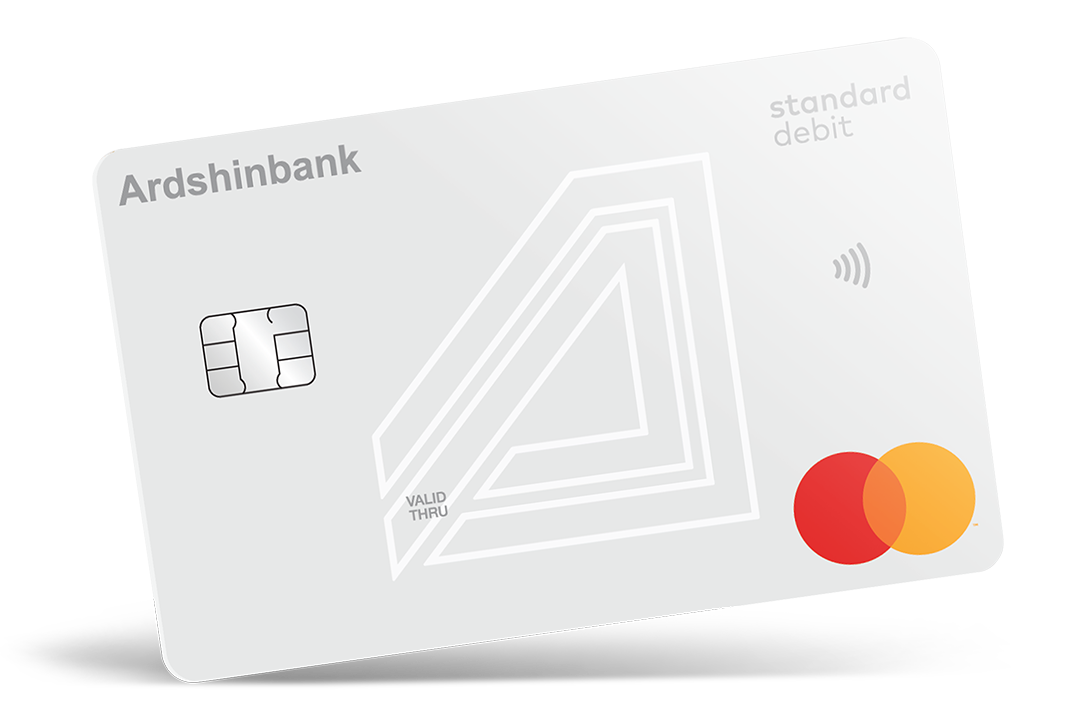
|
N |
Mastercard Standard non-personalized - valid from 11.04.2025 |
AMD |
|
1. General Commission Fees |
||
|
1.1 |
Card issue (release) |
free |
|
1.2 |
Card maintenance fee |
free |
|
1.3 |
Cash withdrawal fees * |
|
|
|
- With cards via ATMs of the Bank and ACBA bank |
0.3% |
|
|
- with tokenized cards via ATMs of the Bank and ACBA bank |
0.5% |
|
|
- POS terminals of the Bank |
1% |
|
|
- with cards via ATMs and POS terminals of other banks integrated into ArCa |
1% |
|
|
- via ATMs of other banks – members of ARCA system, except for the banks that have connected to the Arca processing center through their own processing: Unibank, Inecobank, AMIO BANK, by tokenized cards |
1% |
|
|
- with cards via ATMs and POS terminals of other banks |
1,0%, min AMD 1,500 |
|
|
- with a tokenized card via ATMs of other banks |
1,5%, min AMD 1,500 |
|
|
- from cash-desks of the Bank without the card (applicable also in case of closing the card and the card account) |
Subject to the terms of cash transactions for individuals |
|
1.4 |
Fees for crediting the card account |
|
|
|
- Up to AMD 200,000 (or a foreign currency equivalent) cash-in from cash desks of the Bank *** |
0.5% min AMD 100 |
|
|
- Over 200,000 (or a foreign currency equivalent) cash in |
free |
|
|
- Card account replenishment via non-cash transfer |
Subject to the tariffs and terms of bank transfers and payments for individual customers |
|
|
- Card account replenishment via ATMs of banks integrated into ArCa Processing Center (Cash-in) |
1% |
|
|
- Card account cash-in via ATMs of banks not not integrated into ARCA Processing Center (Cash-in) |
1,5% |
|
1.5 |
Simple annual (nominal) interest rate accrued to the card account balance*** |
|
|
|
- The balance is above, or equal to, AMD 5,000,000 as of the end of the day |
2% |
|
|
- The balance is below AMD 5,000,000 as of the end of the day |
0% |
|
1.6 |
Commission fee for non-cash payment for goods and services with cards via payment terminals |
0% |
|
1.7 |
Cash-back to the Customer from non-cash payment transaction amount |
- |
* The simple Annual (nominal) percentage rate is the percentage rate specified on an annual basis serving as a basis for the Bank to settle the interest amounts payable to the Customer.
E.g. AMD 1,000 * 5% = AMD 50 per 365 days
The annual percentage yield (APY) is the percentage which a person shall receive by applying the simple annual percentage rate for AMD 1,000 over a 365-day period and by way of interest capitalization and payment frequency.
The annual percentage yield of the deposit is the amount obtained from the settlement of the interests payable at an annual percentage yield interest rate.
The procedure for settlement of the annual percentage yield is defined in CBA Regulation 8/02 “On the Calculation of Annual Percentage Yield of Bank Deposits”.
The Bank shall pay the payable interest amount at the expense of the Customer on a quarterly basis. Under the law of the Republic of Armenia “On the Profit Tax”, the Bank shall, upon paying the interests accrued to the Customer, act as the Depositor’s tax agent, charging profit tax in an amount prescribed by the law on interest amount (profit) and transferring it to the state budget.
** Documents and/or records past the expiry date of storage under the legislation of the Republic of Armenia shall not be provided to the Bank's Customers.
*** In the event and in the process of the disruption of the self-service devices providing services to the Bank or the unavailability of the accounts and the impossibility of replenishing the cards being maintained in the Bank, as well as for branches of the Bank (CSD) not equipped with such self-service devices, AMD 0 (zero) tariff shall be established.
In addition to the procedures prescribed in the tariffs herein, additional service commissions may be applied by the maintenance bank for cash-out transactions.
1. The fields on the front and back of the card (in particular, the card’s magnetic stripe) contain data about the payment card, which, if accessed by unauthorized persons, may lead to card fraud.
2. The payment card may be damaged due to changes in the temperature of the magnetic strip, the impact of physical force or other reasons. The card cannot be stored near mobile phones, household and office equipment. The Bank reissues the damaged card according to the current tariffs.
3. The cardholder is obligated to ensure the confidentiality of the PIN-code and its inaccessibility to third parties on the basis of the security objectives of the card. The Bank is not liable for the illegal and unauthorized use of the card due to the disclosure (provision) of the PIN by the cardholder to third parties.
4. The PIN-code of the payment card is not used for making transactions on the Internet or other contactless transactions. Therefore, the cardholder does not have to enter his PIN-code when making transactions on the Internet or other contactless transactions.
5. If the cardholder has confidence or doubts that the PIN-code has become available to third parties, it is necessary to immediately apply to the Bank for blocking the payment card and re-generating a new PIN-code via the servicing SST.
6. The SMS notification service allows the cardholder to specify any amount and receive an SMS message in case of authorization of transactions for the given amount or more. Taking into account that payment card operations are in most cases performed after authorization is received, the cardholder is able to effectively and in real time inquire about any authorized operation. The service is especially important for preventing the use of a payment card for fraudulent purposes.
7. When using a payment card in an Internet environment, the cardholder should pay attention to the presence of a "lock" in the corresponding browser field, the Secure Sockets Layer (SSL) or Secure Web Site record indicates that only the cardholder and the merchant can view payment information (details).
Fraud prevention
1. In order to prevent possible fraud by the payment card, the Bank may automatically block payment cards or transactions if the transactions performed by them, according to the Bank's internal criteria, are considered medium or high risk.
2. In case the cardholder confirms that he has performed an operation that serves as the basis for the Bank to suspend the payment card or transactions, the Bank, at the initiative of the cardholder, can unblock this payment card and transactions.